

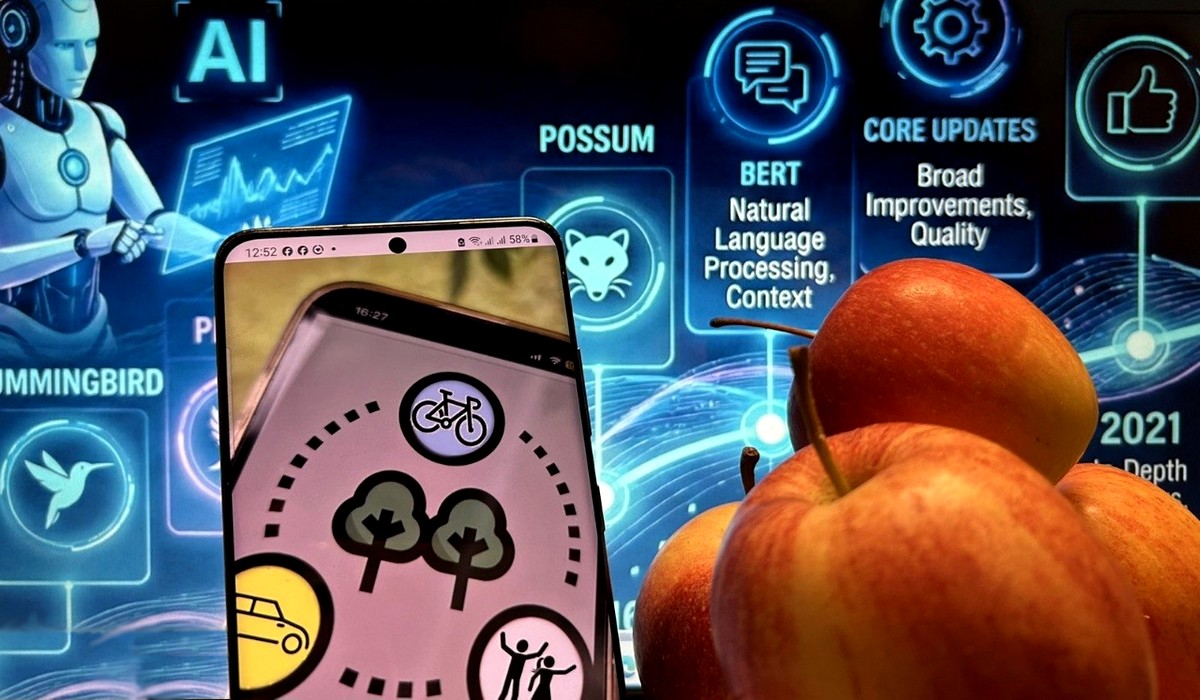
Humanophone, Apples, and Algorithms: How Modern Search Engines Are Losing Users
In recent years, the user search experience has changed dramatically. Major search engines, like Google, are heavily optimized for popularity and SEO, but often neglect the relevance of a minimal query string. The result is user frustration and loss of trust, which quickly translates into losing customers.
Examples of real searches
A user searches for a simple word like “apple” and receives articles about pears or even completely unrelated content. Or they search for “hammer” and the search engine offers an article about a blacksmith. Such examples are not just funny, but they point to a deeper problem with algorithms that predict rather than listen to what is actually written.
A similar phenomenon occurs in the digital media world. The word “Humanophone / Človekofon” at first seemed like an app, but it is actually a satirical column that was the most read and searched post of the month through search engines. If a search engine does not distinguish between context and “metaphorical use,” the user receives incorrect results, which reduces trust in the system.
Why Algorithms Make Mistakes
Aggressive guessing:
- Search engines often try to guess what the user is thinking instead of first searching exactly for the typed word.
- Popularity > relevance: Algorithms prioritize content that is optimized or shared, not necessarily what is most relevant to the query.
- Fragmented or local content is overlooked: Less-known blogs, local media, or rare mentions often don’t appear on the first page, even if they are the most relevant ones.
How loss of trust leads to loss of customers
When users repeatedly receive irrelevant results, they quickly lose trust in the search engine or platform. In a digital environment, this means:
- less clicks on the website,
- more visitors turning to competitors,
- reduced engagement and lower conversion.
If companies or algorithm developers do not take this into account, a poor search experience can directly impact business outcomes.

How Algorithms Could Work Better
Analysis and discussion of the ‘human phone’ and apples reveal practical improvements that could be implemented:
- Minimal input acceptance: The system first ‘catches the ball’—the exact word or phrase—before starting to make predictions.
- Targets and hypotheses: AI can generate multiple options (application, art project, satire, local word) and present them to the user instead of immediately drawing conclusions.
- Transparency: the user sees why a particular result is suggested (number of mentions, popularity, local context).
- Ask the user: AI can confirm the context (‘Do you mean Apple as a company or apple as a fruit?’).
- Hierarchy of relevance: exact word/phrase → related terms → popularity → broader context.
Such an approach not only improves the user experience but also maintains trust and reduces customer loss.
My Conclusion
The digital world is full of fragmented, metaphorical, or localized information that search engines often overlook. The real challenge is not only technological but also psychological and user-oriented. Users want the system to listen to them, not predict them.
If algorithm developers incorporate the principles of a “listening search engine,” they will create a platform that is relevant, transparent, and user-friendly – thereby maintaining trust, engagement, and business results.
Follow the next path to AI Manifest 2.0 >>
FAQ frequently asked questions
Is it wise to trust every answer from artificial intelligence?
Absolutely not. From the analysis and report (AI stress test 1.0) above, it is clear that it is not advisable to believe everything AI says.
Are there any other pieces of evidence and analyses showing how AI fails the stress test?
There is evidence, and it will be published in the next series about the AI manifest.


[…] AI Manifest 3.0 << Back to l Follow the path back to the beginning >> AI Manifest 1.0 […]
[…] Here are the results of the research >> Humanophone, Apples, and Algorithms: How Modern Search Engines Are Losing Users […]
[…] Here are the results of the research >> Humanophone, Apples, and Algorithms: How Modern Search Engines Are Losing Users […]